
Huwy, your AI exploration assistant
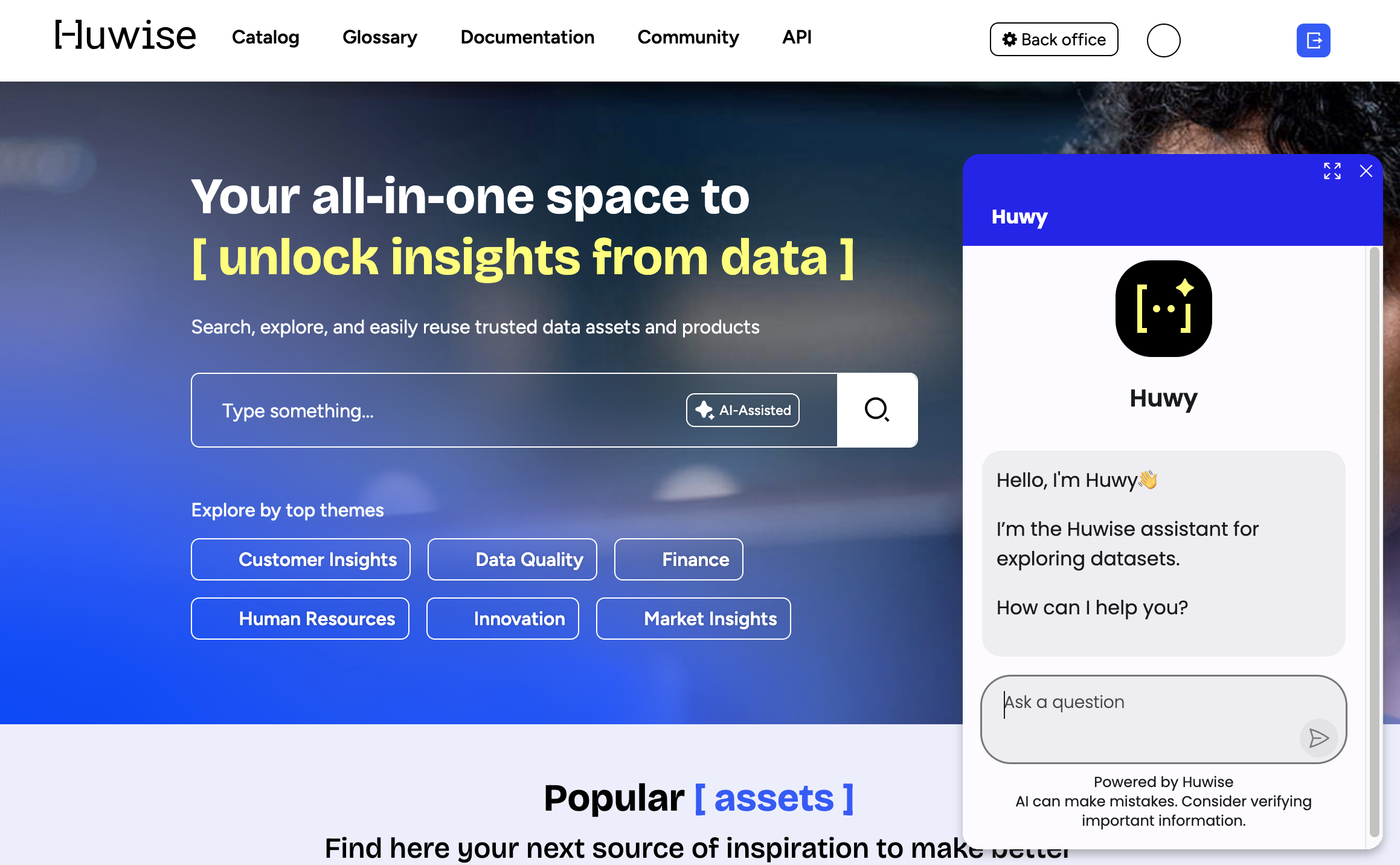
Huwy is an optional AI assistant built into the Huwise data marketplace experience.
Use Huwy to augment your productivity. You can ask it questions to discover datasets, explore them, and understand what they contain—without needing to compose complex queries or hunt through a catalog by hand.
Want to be a part of our vanguard group of users? Contact your CSM or our Support.
What Huwy does
Huwy is best used as a tool to accelerate data discovery and exploration — to help you understand and navigate data before going further.
Here are typical things Huwy can help you accomplish:
Discover the assets you need
Understand a dataset's structure and fields
Ask analytical questions (aggregations, proportions, comparisons, etc.)
Get tentative explanations and insights based on the available data
Explore data directly from anywhere in the marketplace interface
To get the most out of Huwy
Note that Huwy can currently speak only English or French. You should specify which language you wish to use before beginning.
Huwy does not guarantee exhaustive answers by default. Be explicit in your questions — define the scope, state which time period you're looking for, the kind of data you wish to use, etc.
Ask follow-up questions to refine or clarify results
When a result is unclear or surprising, ask: “How did you arrive at this result?”
Remember that, as with any AI-enabled service, Huwy may misunderstand its task or indeed make mistakes! Treat answers as a starting point for exploration, not as a definitive conclusion.
Also note that for now Huwy has only short-term memory. If you reload the page, the conversation will be lost.
Huwy for admins
Administrators can configure Huwy's visibility and appearance, as well as manage quota usage. For more information see Configure your Huwy assistant.
FAQ
Does Huwy use my data to train an AI?
Huwy explicitly does not use a portal's data to train itself nor the AI model you select to drive the feature.
The data used to respond to your request necessarily goes through the AI. But the bottom line is that Huwy is consistent with our existing built-in and legal protections of both you and your data.
Does Huwy have special permissions?
No. Huwy respects the same access rules as the platform. Answers depend on what the user is allowed to see.
As such, anonymous users or users with limited permissions only see data and metadata they are already authorized to access.
How does Huwy work?
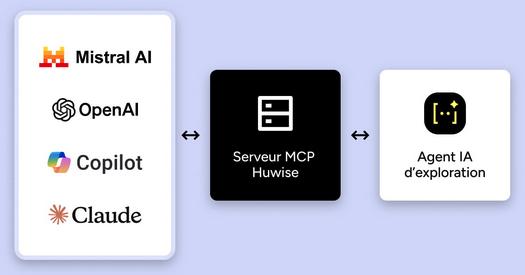
Huwy connects to the platform through the Huwise MCP Server, which provides controlled, structured access to marketplace assets and tools. Through this connection, Huwy can identify data assets, inspect their schemas and metadata, and —when the user has the appropriate permissions — use the data itself to generate answers or insights.
Note that Huwy is designed to be concise rather than exhaustive. It is powered by a probabilistic language model, so two answers to the same question may differ slightly in wording or presentation. When a question is clearly scoped, however, any calculated results will be consistent.
Can Huwy browse the internet?
No. Huwy does not browse the internet. Any external information comes from the model's training, not from live sources.
What languages does Huwy speak?
Huwy currently speaks only English or French. You should specify which language you wish to use before beginning.
Can I access a history of my conversations with Huwy?
Not for the moment. Note that for now Huwy has only short-term memory. If you reload the page, the conversation will be lost.
Does Huwy replace Huwise's other AI-enhanced services?
No. Huwy does not replace our AI-powered semantic search.
The AI insights or Explore data with AI tabs is an add-on feature. Huwy provides similar capabilities, but while Huwy allows users to improve responses through interactive dialogue, it does not yet support chart generation, a feature currently available in ‘Explore data with AI.’
What outputs can Huwy produce?
For now, Huwy can only generate formatted text responses (Markdown) based on the data it has access to through our MCP server. As the feature develops, it will be capable of producing a wider variety of outputs.